
How to do Pedestrian Crossing
You MUST NOT park on a crossing or in the area covered by the zig-zag lines. You MUST NOT overtake the moving vehicle nearest the crossing or the vehicle nearest the crossing which has stopped to give way to pedestrians
There are 6 different types of pedestrian crossing:- School crossing, Zebra, Pelican, Puffin, Toucan and Pegasus.
The examiner on your driving test will expect you to: -
The examiner will also be looking to see that you:-

School Crossing
 Rules for Pedestrians
Always wait for the lollipop person to tell you it is safe to cross.
Always cross in front of them.
If you are on your bike, always dismount before crossing.
You must stop when a school crossing patrol shows a stop for children sign.
Rules for Drivers
Under the Road Traffic Regulatiion Act 1984 it is an offence not to Stop when signalled to do so:
When a school crossing patrol officer steps into the road you must Stop (Rule 87 of the Highway Code):
If you do not Stop, the consequencies can include:
fatalities/serious injury
There may be a flashing amber signal below the school warning sign to alert you that children may be crossing the road ahead. Drive slowly until you are clear of the area. Be cautious when passing a stationary bus showing a school bus sign.
Visit our Video Lesson page - Dealing with School Crossing Patrols
Zebra crossing
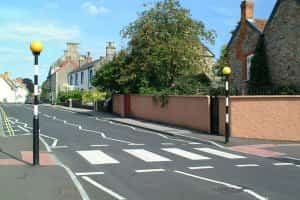
A Zebra crossing is a path across a road marked with black and white stripes where pedestrians
may cross.
They have NO traffic lights.
Rules for Pedestrians
Using the crossing should give traffic plenty of time to see them and to stop before starting to
cross.
Vehicles will need more time when the road is slippery. Remember that
traffic does not have to stop until someone has moved onto the crossing.
Wait until traffic has stopped from both directions or the road is clear
before crossing.
Keep looking both ways, and listening, in case a driver or
rider has not seen you and attempts to overtake a vehicle that has stopped.
Rules for Drivers
Approaching a Zebra cosssing is made aware of the crossing because of its black and white poles with flashing yellow beacons
and zig-zag road markings.
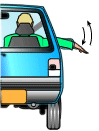 As you approach a zebra crossing look out for people waiting to cross and be ready to slow down or stop to let them cross. Use your mirrors frequently on approach so you know exactly what following traffic is up to and stop before the white dotted line - not after it.
If you have time, give an arm signal for slowing down like the one on the right. This lets the pedestrians know what you are doing and also warns other vehicles that you are stopping.
You MUST give way when someone has moved onto a crossing.
Do Not wave people across; this could be dangerous if another vehicle is approaching and don't flash your headlights!
Try and make eye contact with anyone waiting. This helps reassure them that they have been seen.
Be aware of pedestrians approaching from the side of the crossing after you have stopped.
Visit our Video Lesson page - Dealing with Roundabouts and Crossings
Pelican(Pedestrian Light Controlled Crossing)
These are signal-controlled crossings operated by pedestrians.
The name derives from a cute pseudo-acronym for 'Pedestrian Light Controlled', with the 'o' changed to an 'a' in deference to the bird. The use of improbable animal symbols began in 1951 with the introduction of 'Zebra' Crossings.
Rules for Pedestrians
Push the control button to activate the traffic signals.
When the red figure shows, do not cross.
When a steady green figure shows, check the traffic has stopped then cross with care.
When the green figure begins to flash you should not start to cross. If you have already started you should have time to finish crossing safely.
At some pelican crossings there is a bleeping sound to indicate to blind or partially-sighted people when the steady green figure is showing, and there may be a tactile signal to help deafblind people.
Rules for Drivers
Approaching a Pelican crossing is made aware of the crossing because of its traffic lights and zig-zag road markings. Iron railings are usually used to stop pedestrians entering the road away from the crossing.
Plan what you are going to do before you get there. If, for example, the lights are on green for some time and people are waiting at the crossing, be prepared to slow down as they could turn to red!
Use your mirrors frequently on approach so you know exactly what following traffic is up to and stop on the white line - not after it!
These are signal-controlled crossings where flashing amber follows the red 'Stop' light.
You MUST stop when the red light shows.
When the amber light is flashing, you MUST give way to any pedestrians on the crossing. If the amber light is flashing and there are no pedestrians on the crossing, you may proceed with caution.
After the lights start flashing, watch out for people making a last-minute dash. Be prepared to let them cross but no not wave others onto the crossing.
Puffin (Pedestrian User-Friendly Intelligent crossings)
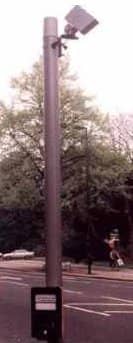 These differ from pelican crossings as there is no flashing green figure
phase.
These differ from pelican crossings as there is no flashing green figure
phase.
Rules for Pedestrians
On puffin crossings the red and green figures are above the control
box on your side of the road.
Press the button and wait for the green figure
to show..
Infra-red cameras similar to those used to find earthquake victims trapped
under rubble are being used to help people cross the road. Attached to
traffic lights at pedestrian crossings, the cameras extend the time drivers
see red so elderly or disabled people aren't at risk from oncoming traffic.
The new 'smart' system also uses heat sensors to tell if pedestrians are
waiting on the pavement, and can even override the red light shown to
drivers if they've already got to the other side.
It has reduced delays to motor vehicles, and improved crossing conditions for elderly and disabled persons by automatically varying the crossing times.
Rules for Drivers
Approaching a Puffin crossing is made aware of the crossing because of its traffic lights and zig-zag road markings.
Iron railings are usually used to stop pedestrians entering the road away from the crossing
The lights have no flashing amber phase, so the lights just change like a normal traffic light at a junction.
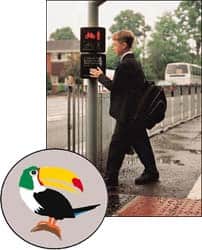
Toucan (Two-Can Cross)
Rules for Pedestrians
On toucan crossings cyclists are permitted to ride across the road.
Rules for Drivers
Approaching a Toucan crossing is made aware of the crossing because of its traffic lights and usually zig-zag road markings (zig-zag marking are not always present).
Iron railings are usually used to stop pedestrians and cyclists entering the road away from the crossing.
The lights have no flashing amber phase, so the lights just change like a normal traffic light at a junction.
Pegasus
 The Pegasus crossing is usually used outside race courses or areas where horses are trained. They appear to be very popular in Scotland.
The Pegasus crossing is similar to any other light controlled crossing, but in addition to provision for pedestrians (as at a Puffin Crossing) and/or cyclists (as at a Toucan crossing) the Pegasus crossing makes special provision for horses.
Rules for Drivers
Approaching a Pegasus crossing is made aware of the crossing because of its traffic lights and zig-zag road markings. Iron railings are usually used to stop pedestrians and horses entering the road away from the crossing
From a drivers point of view, the crossing works in the same way as ordinary traffic lights.
For riders there is a 'high level' push button to operate the crossing. Because this is placed on the traffic-light support, the horse has to come very close to the road in order for the button to be pressed ... So be careful!
Watch out for Pedestrian Refuges
Pedestrian refuges or traffic islands are placed in the middle of wider roads where there is no crossing point. This helps to narrow the road giving pedestrians a safe area to wait whilst they cross the other half of the road. Drivers have priority at these traffic islands.
Practice makes perfect, so get plenty of practice from a Approved Driving Instructor
 How to Do Box Junctions